
The Real Turmeric India Deserves to Know About
Why organic turmeric powder is not just a lifestyle choice — it is a fundamental right of every Indian household that cooks with haldi every single day.
⚠️
A Crisis Hidden in Plain Sight
India is the world’s largest producer, consumer and exporter of turmeric — and yet the FSSAI and multiple independent food safety surveys have repeatedly found that a significant portion of turmeric powder sold in the Indian retail market is adulterated. Lead chromate, metanil yellow dye, Sudan dye, sawdust, chalk powder, and starch from cheaper plants are common adulterants. The very spice we reach for every single day — in our dal, our sabzi, our chai — may not be what it claims to be.
“Haldi is not just a spice in India. It is a ritual, a medicine, a memory. It deserves to be honest.”
Turmeric (Curcuma longa) has been cultivated and revered in the Indian subcontinent for over 4,000 years. In Ayurveda, it is called ‘Haridra’ — the golden goddess — and is considered a tridoshic herb that balances all three bodily energies. Modern science has validated this reverence with thousands of peer-reviewed studies on curcumin, turmeric’s primary bioactive compound, confirming its anti-inflammatory, antioxidant, neuroprotective and anticancer properties.
But here is the uncomfortable truth: to experience these benefits, the turmeric you consume must actually contain meaningful levels of curcumin. And it must be free of the toxic adulterants that compromise both its efficacy and your health. This is precisely where organic turmeric, grown without pesticides, processed without additives and tested for purity, stands apart from the ordinary powder sitting in most spice racks.
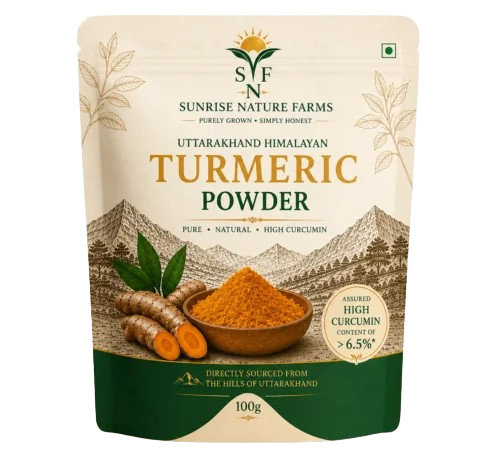
The Sunrise Nature Farms Organic Turmeric Pledge
Our turmeric is single-origin, grown on our certified organic farmland nestled in the clean-air hills of Uttarakhand — where the cool climate, rich mineral soil and high altitude naturally produce rhizomes with exceptional curcumin density. Never exposed to synthetic fertilisers or pesticides. We slow-dry our rhizomes at low temperatures to preserve curcumin and the delicate volatile turmerones. Every batch is third-party laboratory tested for:
- Curcumin content (minimum 3.5% guaranteed on every batch certificate)
- Heavy metals: lead, arsenic, cadmium and mercury — all below WHO permissible limits
- Synthetic dyes — zero tolerance for metanil yellow, Sudan dyes and lead chromate
- Pesticide residues — tested against the full FSSAI panel; consistently non-detect
- Aflatoxins and mycotoxins — food safety non-negotiables
- Microbial safety: salmonella, E.coli, total plate count
We provide batch-specific lab reports with every order. Because you deserve to know exactly what you are feeding your family.
Getting the Most from Your Organic Turmeric
Bioavailability & Daily Use
Curcumin on its own has poor bioavailability — the body absorbs it inefficiently. Two simple co-factors dramatically change this:
The Two Golden Rules of Turmeric Absorption
- Black Pepper (Piperine): Even a small pinch of freshly ground black pepper increases curcumin bioavailability by up to 2,000% by inhibiting its premature metabolism in the liver and intestinal wall. Add it to any dish or golden milk preparation.
- Healthy Fat: Curcumin is fat-soluble. Cooking turmeric in ghee, coconut oil or olive oil — as Indian cooking traditionally has — ensures it is emulsified and absorbed into circulation rather than passing through the gut unabsorbed. Our ancestors’ cooking wisdom is biochemically precise.
Add organic turmeric to your daily dal, stir it into warm golden milk with ghee and black pepper, blend it into chutneys, incorporate it in marinades and soups. The minimum effective culinary dose for anti-inflammatory benefits is approximately ½ to 1 teaspoon per day of high-curcumin organic turmeric — consumed consistently, not occasionally.